Artificial Intelligence (AI) agents are increasingly becoming a central force in the transformation of international business. In a globalized economy where speed, accuracy, and adaptability are critical, companies are seeking innovative solutions to remain competitive. AI agents, which are capable of perceiving data, making decisions, and executing tasks autonomously, offer a powerful tool to support cross-border operations and strategic decision-making.
One of the most significant contributions of AI agents in international business is their ability to enhance communication and customer service. Businesses operating across multiple countries often face challenges related to language barriers and time zone differences. AI-powered chatbots and virtual assistants can provide real-time, multilingual support, ensuring that customers receive immediate and consistent responses regardless of their location. This not only improves customer satisfaction but also reduces the need for large customer service teams.
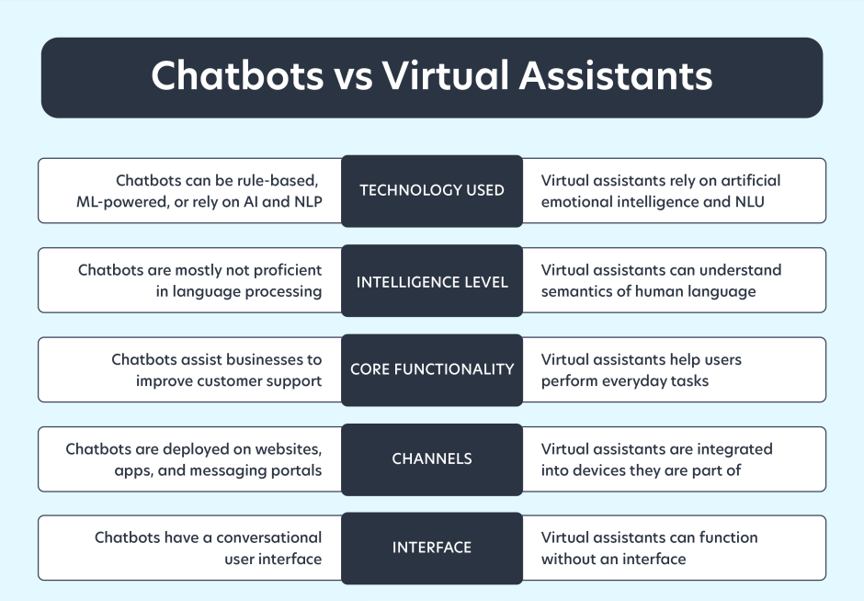
Figure 1: Comparison between chatbots and virtual assistants
In addition to customer interaction, AI agents play a crucial role in optimizing global supply chains. International trade involves complex networks of suppliers, manufacturers, and logistics providers. AI systems can analyze vast amounts of data to forecast demand, identify potential disruptions, and recommend efficient shipping routes. As a result, companies can reduce costs, minimize delays, and improve overall operational efficiency.
Another important application lies in market research and data analysis. Understanding different markets is essential for international expansion, yet traditional research methods can be time-consuming and limited in scope. AI agents can process and analyze large datasets from various regions, providing insights into consumer behavior, emerging trends, and competitive dynamics. This allows businesses to make informed decisions and tailor their strategies to specific markets.
Despite these advantages, the implementation of AI agents in international business also presents several challenges. Issues such as data privacy, cybersecurity, and ethical concerns must be carefully addressed. Different countries have different regulations regarding data usage, which requires companies to ensure compliance when deploying AI technologies. Furthermore, over-reliance on automated systems may reduce human oversight, potentially leading to unintended consequences if not properly managed.
In conclusion, AI agents are reshaping the landscape of international business by enabling more efficient, responsive, and data-driven operations. While challenges remain, the benefits they offer are substantial and continue to grow as technology advances. Companies that successfully integrate AI agents into their global strategies are likely to gain a significant competitive advantage in the increasingly complex and interconnected world economy.
Phan Thi Thu Hang, Faculty of Economics and Management